 |
| |
• Home
• Special Hosted Safaris
• Photographic Safaris
- Lodge based Safaris
- Mobile Safaris
- Boat Safaris
- Destinations
• Birding Safaris
• Cultural Experinces
• Special Adventures
• Photo Galleries
• Who we are
• Notes from the bush
• What our guests say
• Special lectures
• Facts
about Botswana
• Buy
Crafts from Botswana
• Links
• Contact us
Mobile Safaris
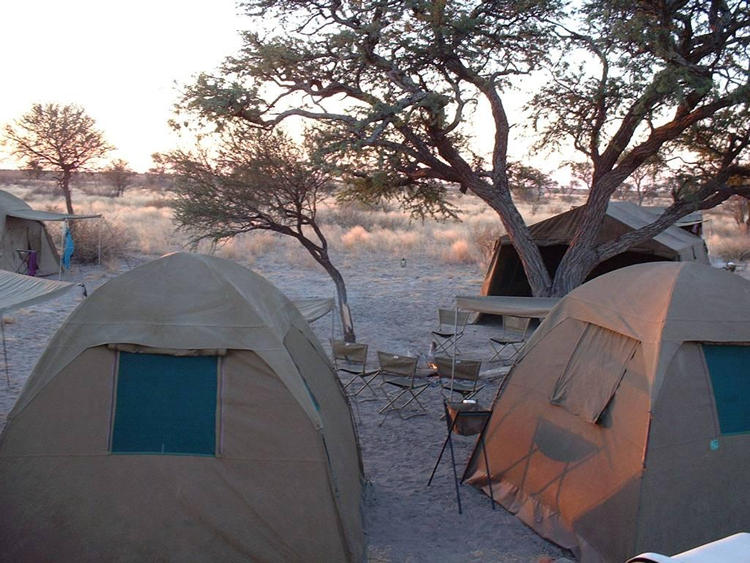
Mobile safaris are just that, the camp moves with you. Accommodations are large spacious "stand up" tents sometimes with, sometimes without, en-suite toilet facilities and large shaded verandahs. All meals are prepared by a professional safari chef and 3 course dinners are served in a large dining tent. Hot showers are available daily (except where water restrictions apply). The safari is well staffed and all that remains for the guest to do is relax and enjoy the wilderness experience.
We
have the two basic itineraries: The 7-day "Best
of the Delta" and our exclusive eco-cultural 11-day "Best
of Botswana". These safaris are luxury-tented safaris that take
you through the wilderness areas of Botswana's Okavango
Delta including Moremi Game Reserve,
the Chobe/Linyanti river system, and Chobe
National Park. The safari passes through some of the finest game
viewing areas in Africa and some of the most pristine wilderness areas
remaining on the planet. The major habitats we travel through include
semi-desert Kalahari scrub, swamps, savannah, grasslands, woodland and
riparian forests. Wildlife viewing opportunities are unrivalled and
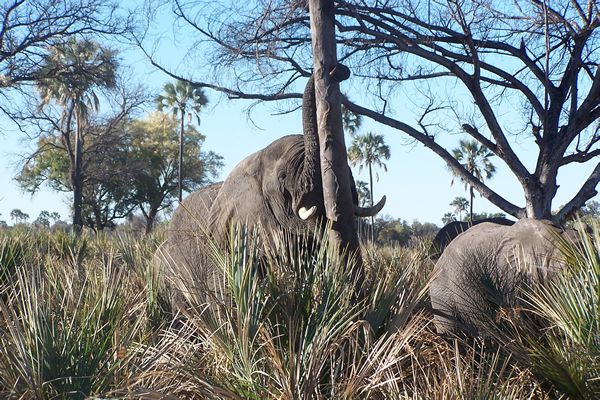
we will see many of Africa's charismatic big game, including the densest
concentration of elephants in the world. Encounters with large predators
are also highly likely. In our "Best of Botswana"
you'll also get a insider's view of some of Botswana's tradtional cultures
that few tourists get to see, plus an oppurtunity to buy unique crafts
from the producers themselves. We also offer the 7 day "Across
the Delta" tour which is similiar to the first 7 days of the Best
of Botswana tour.
Day 1: Maun. Having arrived at Maun International Airport (a big name for a little place) you will be transferred a comfortable lodge on the outskirts of town. Here you can relax and take a hot shower after your long trip.
Day 2: The Delta. A quick breakfast is served at the lodge, before you take a relaxing drive into the Okavango Delta. At the river's edge we meet the guides and Mokoro polers. Fm here you continue on by traditional wooden dug-out canoe (or mokoro). Gliding along the pristine channels, there is excellent opportunity for photography. Your mokoro guide will set up camp in the shade while looking out over the river. After lunch and you've settled in to camp, your guide will take you on an afternoon game walk. Returning to camp in the cool of the early evening for dinner and sitting around an open fire.
Day 3: The Delta. Up before the sun, you set out by mokoro or on foot, to explore the area in search of game. On most walks you may come across zebra, giraffe, elephant, jackal, various antelope, and fantastic bird life. On occasion we also see lion, leopard, buffalo, wild dog, bat-eared fox, hyena and other species. Walks are led by local guides who are part of the community-based program we work closely with. During the hottest part of the day you can cool off in the river, or just relax before the afternoon outing. During the evening your guides will share stories around the fire while listening to the sounds of the African bush.
Day 4: Delta - Maun - Moremi. Up early for those who wish to take a final walk, then cruise back down the crystal clear channels of the Boro to our pick up at around 10.00am. We stop for lunch in Maun then drive on to the South Gate of Moremi Game Reserve, arriving in the afternoon. While your camp is being set up, you'll go on a evening game drive and see why Moremi is considered by many, including ourselves, to be the best game park in Africa, maybe the world. You return to camp in time for a delicious dinner.
Day 5: Moremi. We will get off on an early start as we continue our exploration of Moremi. Today we are likely to see large game such as kudu, impala, zebra, elephant, and lion, and smaller animals and birds such as bat-eared fox or the rare slaty egret. We're also likely to see hippo and red lechwe. We return to camp for a relaxing brunch followed by some free time to shower, and siesta (you'll need it!). We then take an afternoon boat trip to see the nesting sites and heronries on the Xakanaxa and Gadikwe lagoons. Our journey to Gadikwe Lagoons with narrow channels fringed with dense papyrus and Phragmites are adorned with malachite kingfishers, little bee eaters and blue-cheeked bee eaters. The heronry itself hosts thousands of breeding and roosting birds in the early summer. We return to camp for a well-earned dinner and relax around the campfire..
Day 6: Moremi to Maun. We do a morning game drive followed by a quick breakfast. Then we drive back to Maun. Upon reaching Maun, you'll get a chance to check your emails and shop a little bit at the grocery store. The night is spent back at a comfortable lodge.
Day 7: Maun. In the morning you'll head back into Maun to meet Mma Kushonya who will teach you how the famous Botswana baskets are made and show you around her shop. Then we say our goodbyes and drop you off at the Maun airport to meet your flight home or continue on your travels in Botswana.
Tour size: The tour is be limited to a maximum of 9 participants unless special arrangements are made.
The fee for the Best of the Delta tour is US$2,950 (2010) per person sharing. This includes all meals from dinner on day 1 to breakfast on day 7 of the tour, all lodgings, ground transportation, boat trips as per the itinerary, reserve entrance fees, and all guiding services (including local guides and tour leaders.)
A single supplement will be charged if you wish to have single accommodation. If we cannot provide you with a rooming partner although you choose to share, the single supplement will become applicable. We will make all reasonable efforts to ensure that a rooming partner is found if you do wish to share.
Not
included are excessive alcoholic beverages, gratuities, telephone calls,
laundry and items of a personal nature. All costs are subject to major
currency fluctuations, fuel price fluctuations and other significant
items that might be beyond our control.
The Best of Botswana is an 11 day Eco-cultural tour that combines world class game viewing with unique cultural experinces only offered by African Excursions.
Day 1: Kasane. You will arrive at Kasane International Airport where you will be met by a representative of the safari company. Transfered by vehicle to your luxury lodge located on the Chobe River where you'll spend your first night. In the evening you'll take a leisurely boat cruise on the Chobe River and get close to a wide variety of wildlife.
Day 2: Victoria Falls. You'll take a guided day trip to the magnificent Victoria Falls. Returning to the lodge for dinner.
Day 3: Kasane to Savuti, Chobe National Park (CNP). After breakfast we depart for the Savuti area of Chobe National Park. Our drive takes us by a small remote craft shop who'd read about Cecilia's efforts in the US and contacted her to sell some of their simple crafts. In the afternoon us pass the famous Pump Pan where the sun sets behind the camel thorn trees with the elephants silhouetted in the foreground. This night will be in spent in a mobile camp set up for you by your guide and his assistant. In camp we should hear the plaintive call of the jackal, often referred to as the 'cry of the Kalahari' and the eerie whooping of the hyenas, infamous inhabitants of the region.
Day 4: Savuti to Moremi Game Reserve (MGR). After breakfast we depart for Moremi Game Reserve. Our drive takes us through ever changing scenery as we pass through Savuti marsh and the famous Mababe depression and follow the Khwai River to our camp. This area is somewhat drier as we are moving east of the delta proper. The change in habitat heralds a change in the dominant wildlife species and we explore all of this before arriving at our new camp. After a late lunch we head out on our evening game drive. We return to camp for dinner.
Day 5: Moremi. Our morning starts off once again with a light, early breakfast followed by a game drive and brunch. In the afternoon we head to the Xakanaxa boat station where you will explore the channels of the Xakanaxa Lediba (Lagoon) and see the permanent waterways and the associated birds and wildlife. Return to boat station and transfer to camp for dinner. After dinner we relax and listen to the chorus of owls.
Day 6: Moremi to Maun. After our early morning game drive and a light lunch, we drive out of Moremi G.R. and head for Maun. Upon reaching Maun, you'll get a chance to check your emails and shop a little bit at the grocery store. The night is spent a comfortable lodge on the outskirts of town.
Day 7: Maun to Ghanzi. In the morning you'll head back into Maun to meet Mma Kushonya who will teach you how the famous Botswana baskets are made and show you around her shop. After lunch, and a stop back at your lodge to collect your things, we head west into the Kalahari proper to the cattle farming town of Ghanzi. Ghanzi is at the cross roads of many cultures. First there were the San Bushmen, then various black tribes such as the Bahereros, the Bakgalagadi, and the Batswana, then the white Afrikaners, who first settled in the area in the late 1800's. Add to that the more recent western expatriate development workers and you've got Ghanzi. You'll spent the night at a Bushmen cultural village.
Day 8: Ghanzi. A full day is planned. In the morning, we'll get up and accompany a small group of Bushmen as they show us how they traditionally gathered plants from the veld, or bush. The small family groups that work at the culural village are from the either the #Hoa or Gwi clan, some of the last clans to give up the traditional hunter/gatherer lifestyle. Peter's adopted grandfather and tracking mentor Xanate is one of the guides and hopefully will be around. After a late breakfast, we'll drive into Ghanzi to get a demonstration of how ostrich eggshell beads are made. Then off to visit the store at Gantsi Craft where Cecilia used to work, That night, back at the culural village we'll watch a traditional Bushmen dance as the women sit around the fire chanting and clapping and the men dance a hypnotic rhythm in a circle round the women. As an extra, we can also arrange for a traditional healer to be there to perform a trance dance, where he has an out of body experience then performs a laying on of hands.
Day 9: Ghanzi to Shakawe. In the morning, we drive back towards the east then turn north along the western edge of the Delta to Etsha 6, the epicenter of Botswana's basket making communities. This is where Mma Kushonya is from. In Etsha 6 you'll get to meet a few more basket makers and see how they live. Next is a push north with successive stops at Etsha 9 and 13 to see wood carvers and a traditional HaMbukusu dance troupe. Then on to Shakawe, and your lodge. That evening we'll relax on the banks of the Okavango River where we'll enjoy sundowners and the incredible bird life.
Day
10: Shakawe. Today we visit Tsodilo Hills, a world heritage
site because of its 100's of ancient rock paintings. Recently the
oldest
known evidence of human religion was found there. We'll be shown
around the "Mountains of the Gods" by a local Bushman guide. Tsodilo
is a really cool place that gets few international tourists. In
addition to the rock paintings there are numerous caves for the
adventurous to explore. That evening we'll go for a relaxing boat
cruise on the Okavango and see the many crocodiles and prolific
bird life.
Day
11: Shakawe to Maun. On your final day on safari you will leave
Shakawe drive back to Maun and catch your flight home.
Tour size: The tour is be limited to a maximum of 9 participants unless special arrangements are made.
The fee for the Best of Botswana tour is US$5,500 (2010) per person sharing. This includes all meals from dinner on day 1 to breakfast on day 11 of the tour, all lodgings, ground transportation, boat trips as per the itinerary, reserve entrance fees, and all guiding services (including local guides and tour leaders.)
A single supplement will be charged if you wish to have single accommodation. If we cannot provide you with a rooming partner although you choose to share, the single supplement will become applicable. We will make all reasonable efforts to ensure that a rooming partner is found if you do wish to share.
Not included are excessive alcoholic beverages, gratuities, telephone calls, laundry and items of a personal nature. All costs are subject to major currency fluctuations, fuel price fluctuations and other significant items that might be beyond our control.
OPTIONAL EXTENSION:
4 day extension to the Makgadikgadi Pans. You may add on an extra day in the Makgadikgadi Salt Pans and 3 days in Nxai Pan National Park.
6 day extension to the Boteti River in Makgadikgadi Pans National Park and the Central Kalahari Game Reserve. You can add on a night at Meno A Kwena Lodge on the Boteti River and then do a 5 night trip into the Central Kalahari Game Reserve.
|
Womens Work Botswana |
©2006 African Excusions All rights reserved